Star Trek, Classic Communicator
By Richard A. Coyle
The Classic Trek Communicators
By Richard A. Coyle
Next to the Classic Phaser, the Star Trek Communicator is one
of Science Fictions most popular props. This is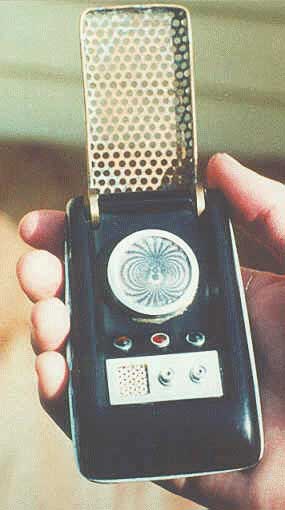 also one of Treks most accurate predictions, the hand held communication
device. Back in the mid-sixties, the idea of such a technological marvel
was only a dream, but nowadays we think
nothing of a cell phone with caller ID,
custom ringing, light up activation, and even internet text readouts.
But in the make believe business of science fiction film and television,
it is a real challenge to conceive and create props that are even remotely as
far fetched and sci-fi-ish as the everyday gadgetry we take for granted. Moreover,
it is nearly impossible to make truly futuristic looking props. Alas, the days of the old winky blinky
LEDs are gone.
also one of Treks most accurate predictions, the hand held communication
device. Back in the mid-sixties, the idea of such a technological marvel
was only a dream, but nowadays we think
nothing of a cell phone with caller ID,
custom ringing, light up activation, and even internet text readouts.
But in the make believe business of science fiction film and television,
it is a real challenge to conceive and create props that are even remotely as
far fetched and sci-fi-ish as the everyday gadgetry we take for granted. Moreover,
it is nearly impossible to make truly futuristic looking props. Alas, the days of the old winky blinky
LEDs are gone.
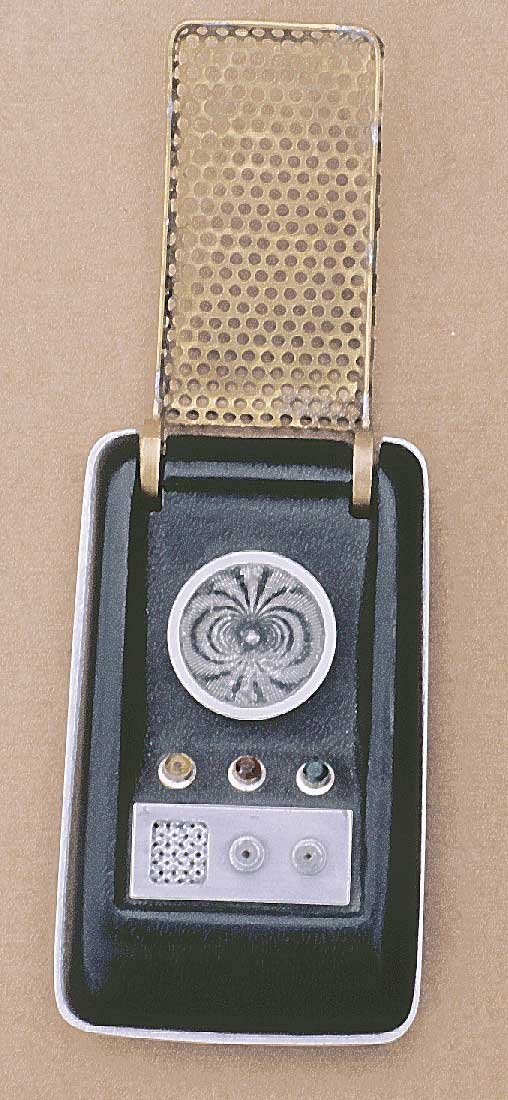 Star Treks classic years had some really great designs -- ones
that never really look too outdated. The
communicator is one of these. With
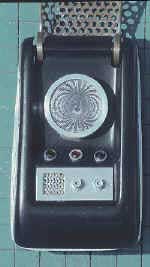
its black plastic body and flip-up grid antenna, speaker grill, three indicator
lights, and two knobs, it truly looks real, not unlike an actual mini walkie-talkie
radio.
And with the working twirling moiré running in a couple of close-ups,
the communicator really looked like something out of the future.
Star Treks classic years had some really great designs -- ones
that never really look too outdated. The
communicator is one of these. With
its black plastic body and flip-up grid antenna, speaker grill, three indicator
lights, and two knobs, it truly looks real, not unlike an actual mini walkie-talkie
radio.
And with the working twirling moiré running in a couple of close-ups,
the communicator really looked like something out of the future.
OK, enough prop worship. Here
is some real insider dope: the working moiré was run by a stopwatch. The
propmakers removed the lens and cover of a stopwatch and then mounted the bottom
disk to the second hand of the stop watch, which on an old analog piece ran
at ten rpm per second. When
started, round and round the moiré would spin, just a touch jerkily due to the
machined movement of the stopwatch as it ticked off each tenth of a second.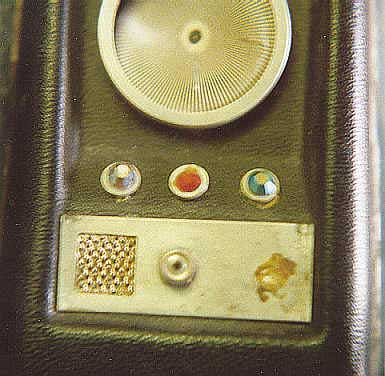
There are a few episodes that hint of this set-up. The
first is Number 50, "Patterns of Force,"
by
J.J. 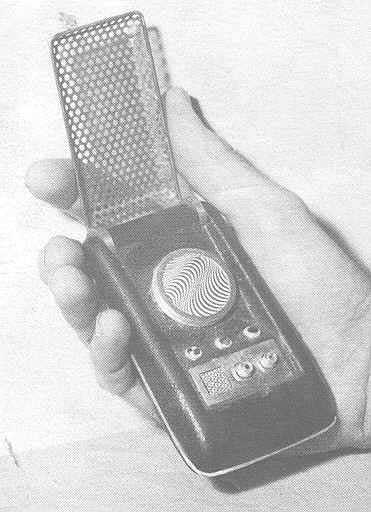 Lucas, which aired in the second season on 2/16/67.
This is the famous episode where Kirk and Spock had to solve the problem
of a Star Fleet sociologist who had violated the Prime Directive and imposed the Nazi ruling system on a planet in order to
bring order to its society. There
they were captured, and their equipment was taken and disassembled to divine
the inner workings.
At one point, Mr. Spock had to reassemble a working communicator from
the parts of the two dissected units, and it is in this scene that you can see
the cut-out in the center frame that normally held the stopwatch. Rumor
has held that the only communicator that could be taken apart was one of the
"working" models. All
others were glued together, so evidently they took apart one of these hero pieces
to use it for this particular shot.
Lucas, which aired in the second season on 2/16/67.
This is the famous episode where Kirk and Spock had to solve the problem
of a Star Fleet sociologist who had violated the Prime Directive and imposed the Nazi ruling system on a planet in order to
bring order to its society. There
they were captured, and their equipment was taken and disassembled to divine
the inner workings.
At one point, Mr. Spock had to reassemble a working communicator from
the parts of the two dissected units, and it is in this scene that you can see
the cut-out in the center frame that normally held the stopwatch. Rumor
has held that the only communicator that could be taken apart was one of the
"working" models. All
others were glued together, so evidently they took apart one of these hero pieces
to use it for this particular shot.
Classic Communicators Page Two
 Also, there are a
couple of shots (in the Nazi episode) where you can see the brass rod mounted
just under the center plate at the bottom.
This rod was used to push the stem of the stop watch to start and stop
the moiré action.
Also, there are a
couple of shots (in the Nazi episode) where you can see the brass rod mounted
just under the center plate at the bottom.
This rod was used to push the stem of the stop watch to start and stop
the moiré action.
Another tidbit of information: the two moiré systems seen on Star Trek – i.e., those of the communicator and tricorder, were made from the same moiré pattern. The tricorder pattern was identical to that visible at Mr. Spock’s science station in the view screen. One was cut out on center, while the other was cut off center from the same ring of radiating circle of lines
What about the knobs, you ask? In fact, these did not hold up well at all on the set, and on most original classic communicators, the knobs are ratty, worn-out little things now, because they were made of plastic. In fact, they were the wheel hubs of a toy car – a model slot car that came out in 1964: the Aurora Model Motoring Slot Car.
There
were essentially three body styles: the full textured; the lightly textured,
which was a full
textured body that was either well worn or intentionally sanded to nearly
smooth; and
last, the completely smooth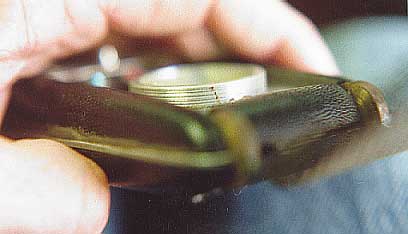 body.
body.
There were only two styles of speaker grills seen on the Classic Communicator. The most common was the "spider" moiré, while the other was the “wavy linesâ€
The Classic Trek Communicators
By Richard A. Coyle
Next to the Classic
Phaser, the Star Trek Communicator is one of Science Fictions most popular props. This is also one of Treks most accurate
predictions, the hand held communication device. Back
in the mid-sixties, the idea of such a technological marvel was only a dream, but nowadays we think nothing of
a cell phone with caller ID, custom ringing,
light up activation, and even internet text readouts.
But in the make believe business of science fiction film and television, it is a
real challenge to conceive and create props that are even remotely as far fetched and
sci-fi-ish as the everyday gadgetry we take for granted. Moreover,
it is nearly impossible to make truly futuristic looking props. Alas, the days of the old winky blinky LEDs are
gone.
Star Treks classic
years had some really great designs -- ones that never really look too outdated. The
communicator is one of these. With
its black plastic body and flip-up grid antenna, speaker grill, three indicator lights,
and two knobs, it truly looks real, not unlike an actual mini walkie-talkie radio.
And with the working twirling moiré running in a couple of close-ups, the
communicator really looked like something out of the future.
OK, enough prop worship. Here is some real insider dope: the working moiré was run by a stopwatch. The propmakers removed the lens and cover of a stopwatch and then mounted the bottom disk to the second hand of the stop watch, which on an old analog piece ran at ten rpm per second. When started, round and round the moiré would spin, just a touch jerkily due to the machined movement of the stopwatch as it ticked off each tenth of a second.
There are a few episodes that hint of this set-up. The first is Number 50, "Patterns of Force," by J.J. Lucas, which aired in the second season on 2/16/67. This is the famous episode where Kirk and Spock had to solve the problem of a Star Fleet sociologist who had violated the Prime Directive and imposed the Nazi ruling system on a planet in order to bring order to its society. There they were captured, and their equipment was taken and disassembled to divine the inner workings. At one point, Mr. Spock had to reassemble a working communicator from the parts of the two dissected units, and it is in this scene that you can see the cut-out in the center frame that normally held the stopwatch. Rumor has held that the only communicator that could be taken apart was one of the "working" models. All others were glued together, so evidently they took apart one of these hero pieces to use it for this particular shot.
Classic Communicators
Also,
there are a couple of shots (in the Nazi episode) where you can see the brass
rod mounted just under the center plate at the bottom.
This rod was used to push the stem of the stop watch to start and stop
the moiré action.
Another tidbit of information: the two moiré systems seen on Star Trek â i.e., those of the communicator and tricorder, were made from the same moiré pattern. The tricorder pattern was identical to that visible at Mr. Spockâs science station in the view screen. One was cut out on center, while the other was cut off center from the same ring of radiating circle of lines
What about the knobs, you ask? In fact, these did not hold up well at all on the set, and on most original classic communicators, the knobs are ratty, worn-out little things now, because they were made of plastic. In fact, they were the wheel hubs of a toy car â a model slot car that came out in 1964: the Aurora Model Motoring Slot Car.
There were essentially
three body styles: the full textured; the lightly textured, which was a full
textured body that was either well worn or intentionally sanded to nearly smooth;
and
last, the completely smooth
body.
There were only two styles of speaker grills seen on the Classic Communicator. The most common was the "spider" moiré, while the other was the âwavy linesâ version. These both came in two sizes, a larger one of one inch diameter, and three sixteenâs wide and three sixteen's high and then a smaller one of about one inch and one eight diameter with the same height. Of both sizes I have seen, all had three grooves cut into the side wall of them.
There were two colors of microphones grills: gold and silver. Their construction was identical.
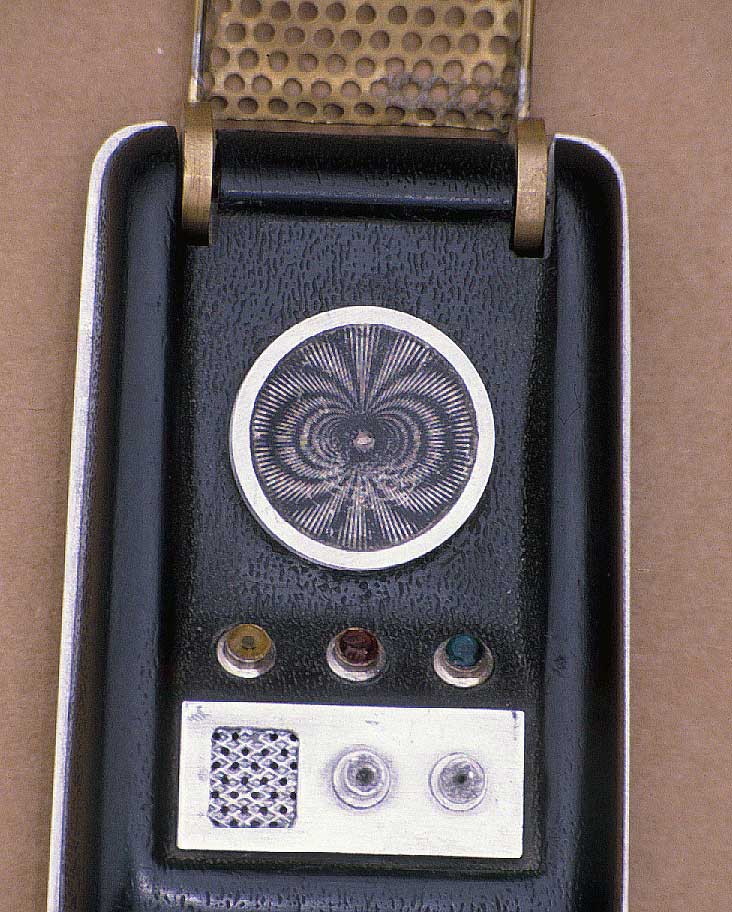 The
antenna grill was perforated brass and soldered to the wire frame, which mounted
both to two brass disks at the rear of the grill via the
wire soldered to the two side and the front lower edge of the grill, forming
an hinge that turned on a metal rod mounted to the
center plate. The back edge of the grill had no wire trim and was left bare.
The
antenna grill was perforated brass and soldered to the wire frame, which mounted
both to two brass disks at the rear of the grill via the
wire soldered to the two side and the front lower edge of the grill, forming
an hinge that turned on a metal rod mounted to the
center plate. The back edge of the grill had no wire trim and was left bare.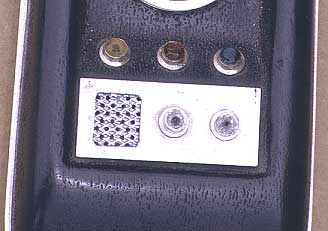
Yellow, red, and green plastic rhinestones were used on all original communicators that I have seen, and they were arranged from left to right in that order. However, the mounting bases for these stones were different from unit to unit. Some seem to sit on ordinary washers, while others seem to be set on round aluminum rods that projected through the face of the bodies. Such rods would have countersunk holes for the rhinestones to set into, and with this style in particular, the center (red) rhinestone was always a touch deeper. The last ring set was made from HO train wheels. The flange of the train wheel became the ring with the rhinestone glued to the top and center hub of the wheel.
One other special
detail, all the Original communicators I have seen, none had the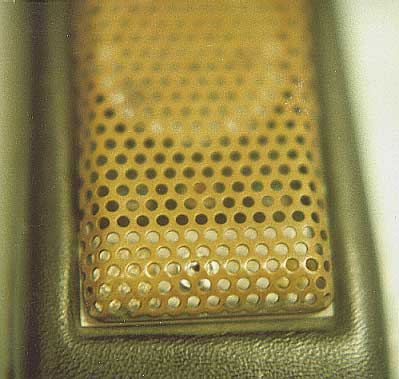 center plate between the two hinge wheels.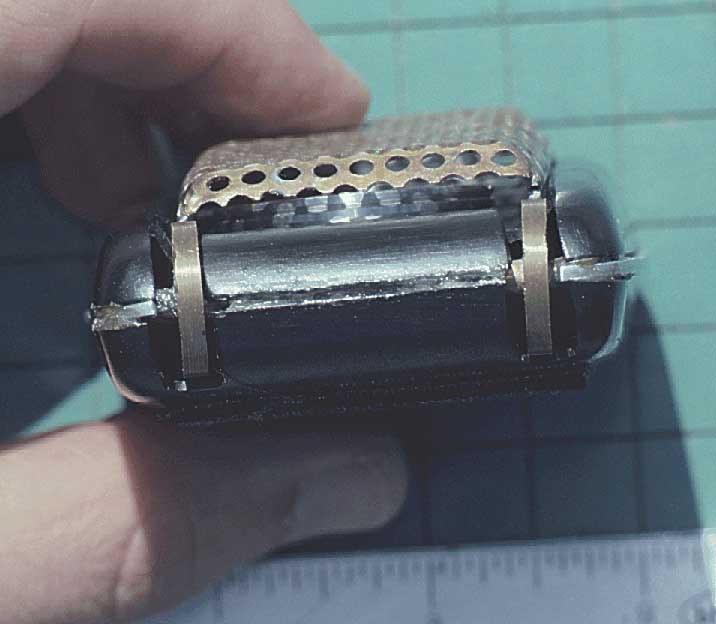
So the next time you flip out your cell-phone donât be too surprised if you reach the Enterprise, they had them first.