On or about 1974 the Trek conventions started to become a pretty big
event which drew many thousands.
Standing behind one table somewhere in the middle of the dealer's hall
sandwiched between dealers selling T-shirts, gum cards, Mego toys, & IDIC
symbols stood a studious looking young man who sometimes wore a Classic Trek
Tunic. His table was basically nothing more than an order form with which you
put your name & address once you ordered his product. Most people as they
passed by his table would hear the ever popular "oohs"&"aahs"
and had to stop, curious to see what the fuss was about.
They quickly found out. This studious looking young gentleman was brandishing
a new groundbreaking item. To most people at that time, it looked like he just
walked off the Paramount lot with an original Star Trek (which was not yet called
classic, since the next de-generation was years away, not to mention the movies)
Phaser 2.
And again to most, it looked absolutely gorgeous, this pioneer copycat
Mr. Brad Nelson, took the time and certainly the expertise to craft his art
to almost the pinnacle of perfection for that period. "Can I see it ?"
said someone. "Wait" said Brad "Let me turn it on so you can
see what it does." Turn it on???
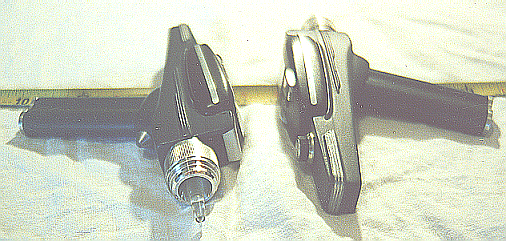
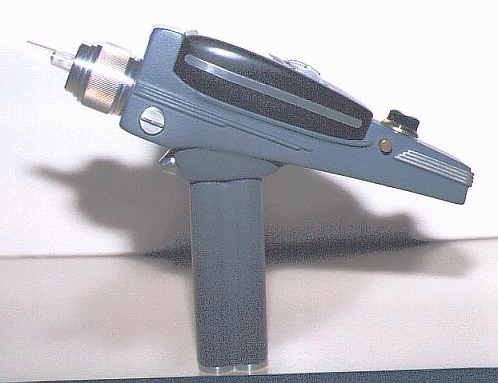
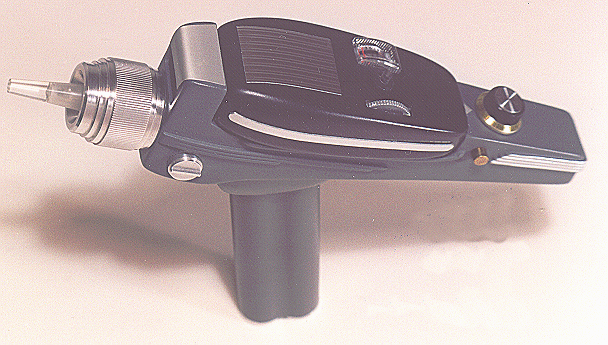
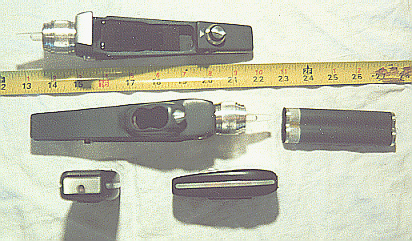
Now that was a shock. A replica that actually looks like an original
phaser, and had machined aluminum parts with all the correct trimmings to boot
was impressive enough for 1974. You mean it actually does something?? We thought
it might have had some sort of lightbulb in it, some quick light up gimmick
that he might have pulled from some kid's toy......Not So!! Brad held the phaser
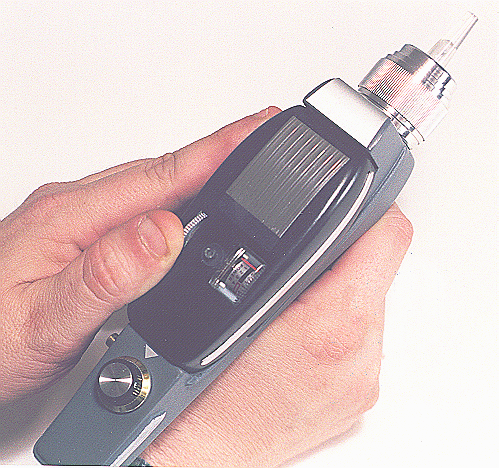
so the top faced him, and turned on the thumb wheel, and a light & meter
were activated. It fired beautifully with sound, was fantastically bright, and
was nothing like a lightbulb. It had 3 settings, the third being the ever popular
"overload".All the controls on this replica worked except the lock
release due to the fact that the phaser 1 was not removable because of the electronics
arrangement.
"How did you manage to make this???" someone asked. Brad
explained. As I explained in my previous installment, like most potential copycats,
Brad noticed the poor quality replicas when ever he saw them at shows, and knew
that he could do better. He hand carved his prototype body from wood, and made
a rubber mold and cast his phasers out of marine fiberglass. He had all the
metal parts professionally made, and then came up with an interesting idea:
He put an actual camera strobe light in it and used a working meter which came
from the audiocassette machines of the day which was pretty close to the size
and look of the phaser meter on the original phaser. For the light between the
meter and thumb wheel, a grain of wheat light was perfect. It had the feel and
the heft of an actual weapon.
CopyCats - Part 2 - Brad Nelson
A little child who could not have been more than 10 or 11 years old strode up
to Brads table. "how much is it???" $50.00 Said Brad. The little kid went over
to a neighboring table where apparently his mother was browsing. He tugged at her skirt
and whispered in her ear. The lady then produced a crisp new $50.00 bill and Brad's first
sale was made. $50.00 was a lot of money in those days. This author was only about 14
years old at that time, and only had about $12.00 on him and that usually went pretty far.
But subsequently much, much, later I begged & borrowed and am happy to say that I do
have one in my collection.
As
the year progressed, Brad would come to about every other show with his new
wonder toy. Therefore it was inevitable that sooner or later the "convention
guests"I.E... the Stars would see his phaser. George Takie (Sulu) happened
by and was quite impressed, so much so that he bought one for himself, As did
Deforest Kelley...After all a doctor needs some kind of protection, you never
know, he might have had to make a house call on Talos 4.
In fact Mr. Kelley liked it so much that in a 1976 appearance on the
"tomorrow" television show with Tom Snyder, he brings it along and briefly
demonstrates it for the cameras. You can sometimes find that on the blooper reel tape
copies that are on sale at the present day conventions.
Sometimes Brad let a friend demonstrate and sell when he was unavailable for a
particular show. This friend then related a time when William Shatner was a guest. He
supposedly asked if he could bring the Phaser up on stage when he spoke. "no
problem" said Brad's friend. So up to the stage went our beloved Captain Kirk, and
future T. J. Hooker to recall all the delightful anecdotes, memories & experiences of
the good old Trek days.
At the end, Brad's friend asked Mr. Shatner if he was interested in buying it.
"Sorry" Said Shatner," maybe some other time". Apparently Starfleet's
pension plan does not allow for fun money.
CopyCats - Part 2 - Brad Nelson
At any rate, from 1974 to 1977 Brad produced a reasonably modest amount of
these pieces, but unfortunately for the collector,eEach replica took 4-5 weeks to make, so
the price went up.. By the end of 1977 Brad's phasers were now $500.00, and at almost that
exact same point in time, the Great Bird Of The Galaxy (Gene Roddenberry) swooped down to
attend a Statler-Hilton Star Trek convention.
"Hey, Mr. Roddenberry" shouted a fan, "you gotta checkout the
dealers room..someone's got one of your working phasers in there". "I'll do that
" said Gene..Actually Mr. Roddenberry had already heard about Brad's phaser, and was
planning to stop by anyway. As Brad was demonstrating his phaser to a prospective
customer, someone said "Excuse me, but may I see that when you are through?" Now
when the great Bird speaks, we all listen.."well young man, I guess my friends were
right. You did a fine job...Better than the guys I hired to do these for me......What's
your name???.. I'll remember that..Do you have a card"? "No" said Brad,
"but I"ll put my telephone number on my order form for you".
Gene Roddenberry definitely had a way with the people that he spoke with. He
put you on equal ground with him, and made you feel comfortable, and never exercised any
superior airs. You immediately felt like you were talking to an old friend.
"Well" said Gene, Can I buy this one?" of course" Said
Brad, who usually only brought one phaser to the shows as a demo model, and shipped the
customer his when he placed his order. But the Great Bird of the Galaxy should not be made
to wait!!! "Thank you...we'll be in touch"...and off he went.
It is believed that very late in 1977 or early in 1978 Brad's telephone
rang at home. "This is Gene Roddenberry..maybe you remember me...I bought
one of your phasers". Now that's a call from a copycat's dreams. It seemed
that Gene was finally going to bring Back Star trek as a made for TV miniseries
entitled Star Trek: phase 2 and wanted Brad to make the phasers that they were
going to use. "Sure!" jumped Brad. However Gene wanted some changes.
Originally Brad used gloss paints on his pieces. Gene requested flats. Mr. Roddenberry
also wanted Brad to do away with the rainbow colored square grid on top of the
phaser 1 to be changed to an all chrome colored straight lined tape, and to
cut down the back knob that was the selector switch. In addition there were
a few more subtle changes he wanted made that would further distinguish these
pieces from the fan bought ones: Gene needed none of the electronics, and he
wanted the phaser 1 to be removable, along with the pistol grip that housed
the AA batteries. Brad used velcro to accomplish these changes and sewed it
through with copper thread and went over the thread with black magic marker.
After they were made, Brad personally went to Paramount Studios, and
hand delivered them. Sometime after that, Brad was summoned to Paramount's legal
offices for a series of three meetings. Apparently Gene Roddenberry was unaware
of the fact that Paramount had given a license to sell Star Trek Merchandise
to Mego Toys. That also included the name "Phaser". The way it was
explained to Brad this fell under the legal nomenclature of "conspiracy
to confuse the public" and therefore his Phasers could not be used, since
Mego's toy phaser was vastly different in appearance From Brad's Full sized
realistic looking replica.
Apparently Paramount & or Remco must have thought that the fans &
public was just too ignorant to see the difference from a cheap inaccurate made for
children's toy, or an authentic in- scale prop replica worthy enough to be used on TV or
even a movie!
I don't know about you readers, but except for shows like "Lost In
Space" I have yet to see any character use a cheap kids toy for a prop, since most
studios, if not all utilize their special effects department to construct what they
need..Guess what Paramount, We can tell the difference!!.
However, the real reason may have been the fact that Paramount studios always
hade a profound dislike of Gene Roddenberry's use of "nonprofessionals" for prop
work, and were looking for an excuse not to allow it this time. In any case, Brad never
saw those phasers he made for Gene Roddenberry again, but continued to make more as time
permitted him, but stopped briefly for a period at approximately 1983.
His last and final Hurrah was at a Toronto Canada Star Trek convention in 1985.
By that time the parts he was using for the electronics became outdated and becoming more
difficult to acquire. Collectors were paying up to $700.00 each for one which was a little
high, but in this author's opinion, still worth it. In lieu of these reasons Brad decided
to shut down Starfleet Research. He felt he had a good run of it, and that it was now time
to move on to bigger & better things. At present he works in silicon valley for an
electronics firm, where his expertise took him as far as Australia, recently. But he still
remembers fondly the possibility of his phasers being used by Captain Kirk&
Crew..."To quote a classic Klingon" says he,.."It might have been
glorious"..
It should also be noted that Brad Nelson was also
afforded the rare privilege of being contacted by the Smithsonian Museum In Washington
D.C. in 1978, and asked if he would donate one of his phasers for their collection of
memorabilia. As of this date, it is not on display, however it is confirmed that they
still have one in their possession from that date...